Joint
The Joint relation is a multinuclear relation without a precise definition in RST. It is used to relate different nuclei of the same type, which do not have a specific relation. In natural language generation the nuclei are often related with an “and”.
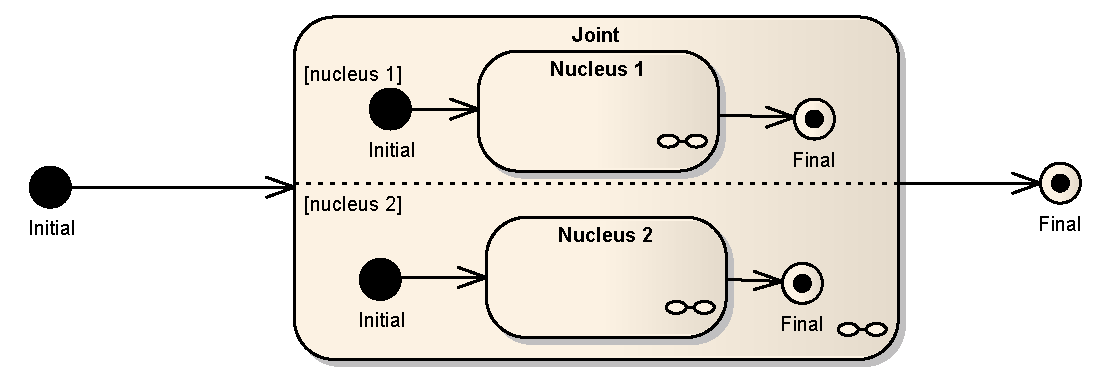
For the use in our Communication Model we defined a Joint relation as follows. The related branches representing the nuclei have to be executed quasi-parallel. In this context this means, that all branches have to be fully executed, but without any specific order, or a parallel. An example for a Joint relation is the relation of the selection of a departure airport and the selection of a destination airport in our FlightBooking example. The Joint relation allows that both questions can be uttered at the same time, but it is also possible to start with only one question and to utter the second one after the first one is answered. After all branches are executed the final states are reached, the Joint’s execution is finished. The Procedural Semantics is shown in Figure Joint as as state chart with two nuclei. The Nucleus x states in the state charts represent the composite states for the nuclei. If there are more than two nuclei modeled, additional regions inside the Joint state are created for each nucleus. These regions have the same structure as the two regions shown in the Joint state.
rpopp |  March 22, 2012 8:38 am
